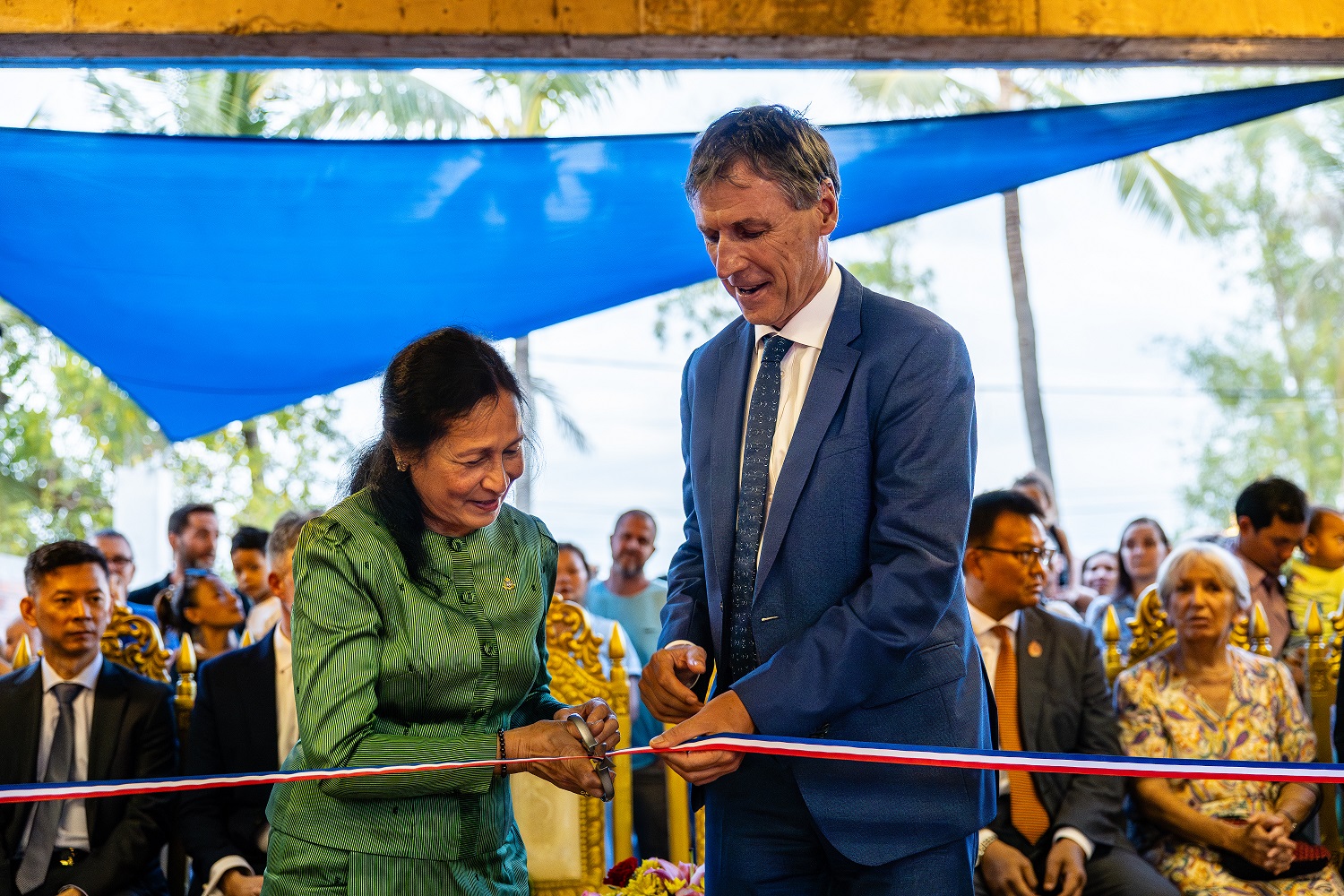
2003: an idea brought to life by two families
The French School of Siem Reap opened on 2 September 2003. Behind the initiative were two families with a clear educational aim: to create a school where children could follow the French national curriculum while living in Cambodia. That starting point placed the needs of families at the centre of the project from its first day.
A French curriculum offered a shared structure for lessons and progression. Children could build knowledge through French while growing up in the surroundings of Siem Reap. The school welcomed French-speaking children from different national backgrounds, giving the project an international character through the families who came together around it. Its identity developed at the meeting point of a French educational framework and everyday life in Cambodia.
2008: parents take a leading role
In September 2008, management of the school passed to the Association des Parents d’Élèves, usually shortened to APE. This marked a new stage in the organisation of the establishment. Families became part of the structure responsible for carrying the educational project forward.
The parent-association model gave the school a community dimension alongside its classroom work. Parents shared an interest in the continuity of their children’s education, while teachers brought the professional knowledge needed to turn a curriculum into daily learning. The arrangement linked the practical life of the school with the educational ambitions that had inspired its founding. By March 2026, the establishment’s presentation continued to describe management by a parents’ association.
Building from the early years and primary school
The school’s earlier presentation set out a pathway beginning with young children. Alongside the Tchin Tchok Club for children aged one to three, maternelle offered three familiar stages of French early-years education: petite section, moyenne section and grande section. These classes introduced children to school life through language, shared routines and age-appropriate activities.
Primary education followed through CP, CE1, CE2, CM1 and CM2. Together, the five classes provided a progression in the central skills of reading, writing and mathematics. The place given to children learning French was also part of the educational approach. Maternelle welcomed children from other language backgrounds, and the later pedagogical programme described additional support in French as the language of schooling.
2009 onwards: a pathway for older pupils
As children grew, continuity became another part of the school’s development. A system of tutoring and support for distance education was introduced in September 2009 for collège-level study. This brought an organised form of supervision to learning that followed a programme beyond the early-years and primary classroom.
The pathway developed further over time. The school’s March 2026 presentation described direct teaching through troisième from the 2023 school year, together with CNED distance learning supported by tutors for lycée students. CNED is France’s Centre National d’Enseignement à Distance. These stages show how the school’s educational project broadened as it addressed the needs of older pupils and the transition towards further study.
2011: recognition and educational connections
The school’s earlier history records French Ministry of Education homologation from 2011. It also describes affiliation with the AEFE, the agency supporting French education abroad. Those relationships connected the Siem Reap establishment with a wider educational network and with professional development for its teaching team.
The school described inspections, continuing training and the opportunity for teachers to keep pace with developments in educational programmes and methods. Its pedagogical programme also referred to collaboration with Lycée René Descartes in Phnom Penh. Together, these connections formed part of the context in which the school developed its French educational pathway in Cambodia.
French learning with English and Khmer
The role of languages became a clear part of the school’s educational identity. French provided the main language of lessons, while English and Khmer widened the learning environment. The programme presented in 2021 described early learning of both languages and the use of English in selected curriculum subjects.
This integrated approach included science in English from CP and history in English from CM. For children developing French, the programme also gave a place to reinforced French teaching in maternelle. Language learning therefore connected academic development with the different linguistic worlds children encountered: French in the curriculum, English in an international setting and Khmer in the country around them.
Learning within a Cambodian setting
The school’s educational ambitions extended to cultural discovery, independence and relationships with other people. Its project gave a place to understanding the local environment, respecting others and caring for the world around the classroom. These themes connected school learning with life in Siem Reap.
After-school activities added another dimension. The programme included examples such as football, tennis, swimming, aikido, chess and yoga, bringing physical activity, concentration and shared interests into the wider school experience. Across its development, the French School of Siem Reap brought together a structured curriculum and a multilingual outlook. Its story follows the growth of that project: an initiative by two families, a parent-led organisation and an educational pathway that developed alongside its pupils.
